
The short answer
A website costs what the work behind it costs, and that work varies more than most people expect. A plumber in Shirley who needs a handful of clear pages and a contact form is asking for a different job from a firm with offices across Hampshire, a booking system and a feed of live vacancies. Both are "a website", but one may need several times the planning, writing and building of the other.
That is why we do not put a figure on this page. We quote every project on its scope after a short conversation about what your site needs to do. The quote is free, written and itemised, so you can see where the effort goes and take out anything you do not need.
What drives the cost of a website
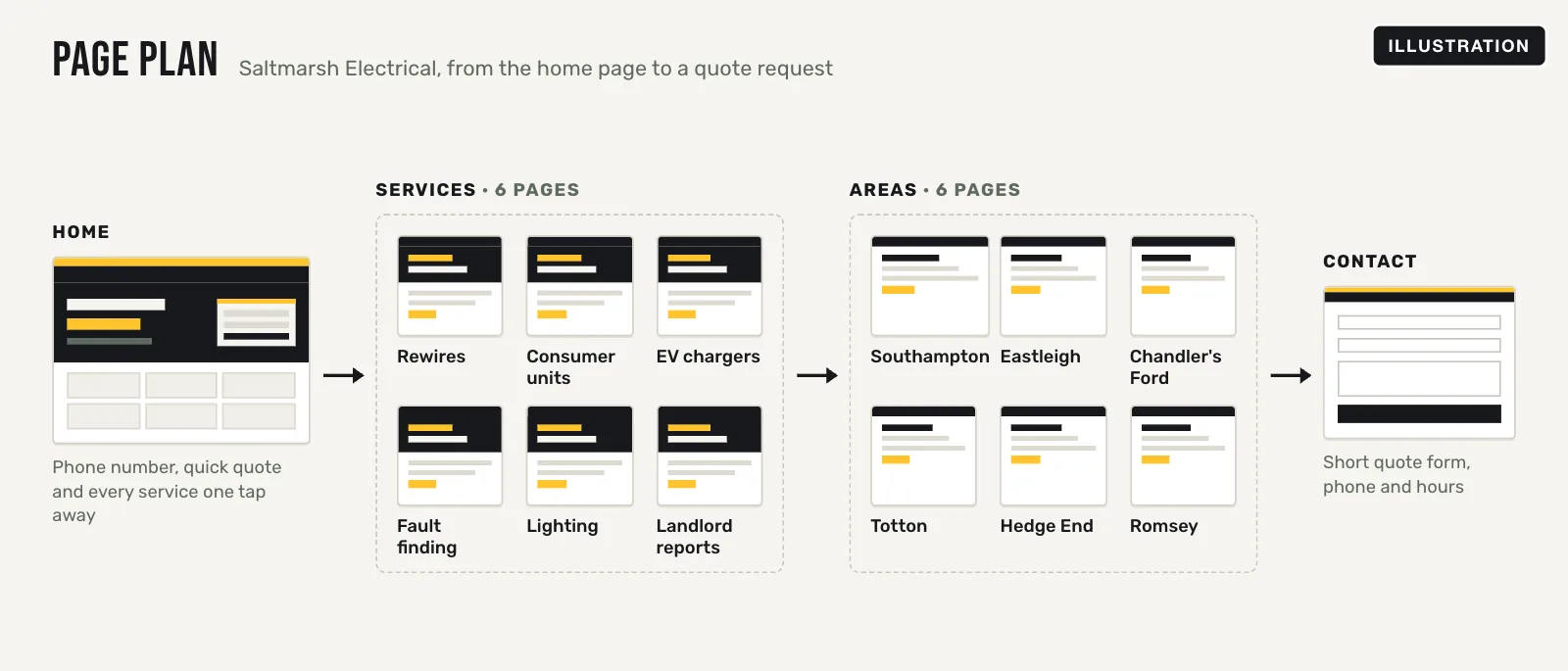
Number of pages. Every page has to be planned, written, designed, built and tested. A five-page site covering your services, your area and how to get in touch is a smaller job than a site with a separate page for each service in each town you cover. More pages can bring in more searches, but only when each one has a real job to do.
Who writes the copy. The words are often the biggest hidden part of a project. If you supply finished text, there is less to do. If we interview you and write every page, including the local detail and the search terms each page should rank for, that takes real time, and it usually makes the biggest difference to whether the site brings in enquiries.
Design depth. A site built on a well-made layout system with your colours, fonts and photos is quicker to produce than a fully bespoke design where every page type is drawn from scratch. Bespoke design suits businesses whose look is part of what they sell; many service firms do well with a simpler approach done carefully.
Features and integrations. Each extra job the site has to do adds development and testing. Common examples:
- an online booking calendar that checks real availability;
- a link to your CRM, so enquiries land with the right person;
- a job or property feed pulled in from another system;
- an online shop with stock, delivery options and payments.
Photography. Real photos of your team, premises or finished work beat stock images almost every time. They may mean a half-day shoot, or a careful sort through photos you already have. Either way it is part of the job.
SEO set-up. Titles, descriptions, headings, structured data, a sitemap, analytics and, on a redesign, redirects from every old page that still earns visits. Skipping this makes a quote look smaller, and it tends to cost more later when rankings drop.
Ongoing care and support. Once the site is live, it needs hosting, security updates, backups and someone watching that it stays up. We cover those in a care plan priced to your site. Changes and new work beyond that, such as a new service page or a new feature, are support, quoted per request or as a block of hours if you expect regular changes.
Three worked examples
These are typical shapes of project, not fixed packages. Your own quote will reflect what you actually need.
A sole trader's five-page site
An electrician working across Southampton and Eastleigh wants a site that makes the phone ring. It needs a home page, a page for each of the two or three main services, an areas-covered page and a contact page with tap-to-call and a short quote form. The owner is happy for us to write the copy from a phone conversation and has decent photos of finished jobs.
This sits at the smaller end. There are few pages, one simple form, no integrations and no shop. Most of the effort goes into clear words and a fast mobile layout. A light care plan keeps it hosted, updated and backed up.
A redesign for an established local firm
An accountancy practice off Bedford Place has an old site that still ranks for a few useful searches. It wants a fresh design, around a dozen pages and a way for clients to book an initial call.
This costs more than the first example, mainly because of what has to be protected. Every old page that brings in visits needs mapping and redirecting so the practice keeps its rankings. The copy needs rewriting rather than writing from nothing, which means checking every claim with the partners. A booking tool adds set-up and testing.
A firm with several offices and a booking system
A recruitment agency with branches in Southampton, Portsmouth and Winchester wants a page per office, a page per sector it recruits for, a live vacancy feed from its recruitment software and online booking for candidate interviews.
This is the largest of the three. Each office page needs genuine local content, the vacancy feed means building and testing a connection to another system, and the booking system has to handle several diaries. There are more people to approve the copy, too. It also needs a fuller care plan, because there are more moving parts to keep an eye on.
Questions to ask any web designer
- Who writes the copy, and how many rounds of changes are included?
- Will I own the domain, the content and the design files once I have paid?
- What happens to my current search rankings when the old site is switched off?
- What are the ongoing costs, and what exactly do they cover?
- How will I update the site after launch?
- What does the quote leave out?
A good web designer in Southampton will answer all of these plainly. If someone cannot, or will not, treat that as useful information.
How we quote
- A short conversation. We ask what your business does, who your customers are and what the site has to achieve. A video call or a few emails is usually enough.
- A free, written, itemised quote. It lists the pages, the writing, the design, any features and the care plan, with a rough timeline. There is no obligation to accept it.
- Clear payment terms. We are not VAT registered. Websites are paid 50% to start and 50% at launch, and you own the site once it is paid in full. Monthly SEO or Google Ads work has a 3-month minimum and then runs on 30 days' notice, with any ad spend paid directly to Google or Meta.
If you would like a quote for your business, get in touch with a short description of what you do and what the site needs to achieve. Before you do, our free website redesign checklist can help you list what you need.